
Beaches, Coasts and Waterfronts
Beaches: Toronto
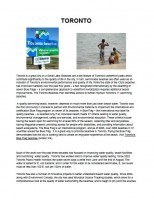
Seven of Toronto's Beaches are certified as “Blue Flag” beaches, which is the international eco-label for quality beaches. Blue Flag beaches must meet 27 criteria in order to be certified as exceptionally healthy, clean, and environmentally-friendly waterfront recreation areas.
Beach Grooming Tactics in Racine, Wisconsin

The City of Racine's Beach Grooming Tactics are intended to reduce swimming bans at the city's waterfront recreation areas. These tactics are intended to reduce non-point source pollution to Lake Michigan. Best Practice submitted in 2010 after implementation began in 2003.
Beaches: Goderich, Ontario

Read about the Town of Goderich, Ontario's beach health programs. Goderich's Rotary Cove Beach is a Blue Flag beach, and the town also participates in the Green Ribbon beach program.
Toronto Beaches: Bluffer’s Park
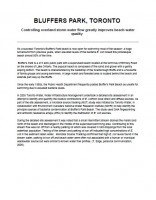
The City of Toronto, Toronto Water, and the Toronto and Region Conservation Authority assessed and rehabilitated the Bluffer's Park beach to reduce contamination from E. coli bacteria. The restored beach is now a high-quality habitat, and water quality has improved dramatically. The Bluffer's Park beach recovery is one of the best examples of beach restoration; pre-restoration, the beach was in a health advisory 80% of the time. Post-restoration, the beach has been open 85% of the time and is now a Blue Flag beach.
Beaches and Coasts Workshop Summary
In April 2010, the Cities Initiative held a workshop on best practices for beaches and coastal areas in the Great Lakes Region, specifically on the lakes that border the Province of Ontario. This series of presentations provided a sense of the current state of Ontario’s beaches and coasts, the important role of tourism and trails, opportunities to improve beaches and coasts, and inspired beach and coastal success stories from around the province. A summary of these presentations is available here.
Beaches Workshop Materials
In April 2010, the Cities Initiative hosted a Great Beaches workshop in Ontario. All presentations from the workshop are included here. Topics included the Blue Flag program, Southern Georgian Bay Initiative, Great Lakes Coastal Environmental Scan, Beach Health in Ontario, Wasaga Beach and Ontario Parks, beaches in the City of Toronto, the Ontario Provincial Trails Strategy, Promoting Great Lakes Beaches and Coasts, and Grand Bend/Lambton Shores Beaches.
All Presentations
- Beaches Workshop Agenda
- New Opportunities (Sarah Rang, GLSLCI)
- Southern Georgian Bay
- Great Lakes Coastal Scan (Eric Boysen, Ministry of Natural Resources)
- State of the Great Lakes Coasts (John Marsden, Environment Canada)
- Improving Ontario's Beaches & Coasts (Sarah Rang, GLSLCI)
- Beach Quality in Ontario (Tim Fletcher, Ministry of the Environment)
- Raising the Blue Flag (Sarah Winterton, Blue Flag Program)
- Ontario Parks
- Toronto Water and Beaches
- Ontario Trails Strategy (Ministry of Health Promotion)
- Promoting our Beaches and Coasts (Ministry of Tourism and Culture)
- Grand Bend Beach Enhancement (Municipality of Lambton Shores)
Smart Growth For Coastal & Waterfront Communities

Developed in consultation with the national Smart Growth Network, the interagency guide builds on the network's ten smart growth principles to create coastal and waterfront-specific strategies for development. The guide includes an overview of the unique development challenges and opportunities along the water and provides specific approaches to development that include a description of the issues, tools and techniques, and case studies.
Dune Swales: North Beach Project (Racine, WI)

The City of Racine created dunes and covered them with vegetation to answer many issues the area faced. Now these structures limit the beach erosion caused by rain and wind, limit the use of the beach by seagulls, and aid the infiltration of non-point source pollution.
Preparing for the Impacts of Climate Change on Stormwater and Floodplain Management – A Preview of Adaptation Plans and Practices

This study aims to summarize what has been done to date in adapting stormwater and floodplain management practices to prepare for the impacts of climate change, both in Canada and elsewhere. The specific focus of this review was on identifying adaptative approaches to the planning and design of stormwater management and drainage infrastructure, as well as changes in land use and floodplain management practices to account for the potential impact of climate change on drainage infrastructure and flood vulnerable areas.
Developing Our Coastlines – Four Michigan Communities Take Stock of Their Great Lakes Assets

In 2005, the Michigan Environmental Council conducted a study regarding the coastal development in Michigan. It consulted four communities to do so.